

Why is iJS Munich 2026 particularly relevant this year?
The question for development teams is no longer whether AI will influence software engineering. It already does.
The more important question is how teams can use AI agents without sacrificing architecture, predictability, security, and maintainability.
At iJS Munich 2026, agentic development is therefore not treated as a collection of isolated AI demos. The program looks at what happens when agents become part of real engineering workflows: when they can generate code, interact with applications, use tools, work with shared state, and make changes that have consequences beyond a single prompt.
For you and your team, this means gaining practical guidance at the point where many organizations are still defining their own standards.
Instead of discovering the limitations of agentic development through production incidents, unmaintainable code, or security problems, you can learn from concrete patterns and approaches that are already emerging across the industry.
How can you move AI agents from experiments to engineering discipline?
AI coding tools can produce code quickly. The harder problem is making sure that code still respects the architecture and conventions of your application.
Several topics at iJS Munich address exactly this challenge.
Sessions around WebMCP, MCP Apps, AI-assisted Angular development, shared application state, and agentic user interfaces explore how agents can interact with software in a more controlled and predictable way.
One of the central ideas is simple: if an agent is going to work inside your codebase, it needs rules.
Architecture boundaries, state-management conventions, permitted actions, and UI constraints cannot exist only as knowledge in the heads of experienced developers. They increasingly need to become explicit enough that both humans and AI-supported development workflows can follow them.
For teams already experimenting with coding agents, this can help answer questions such as:
- Which parts of an application can an agent change independently?
- Where do we need strict architectural contracts?
- How should an agent interact with shared application state?
- How can we prevent AI-generated functionality from bypassing established patterns?
- When should an agent generate an interface freely, and when should it operate inside a predefined structure?
The Agentic UI with Angular workshop adds a hands-on dimension, giving participants the opportunity to work directly with agent-driven interfaces rather than only discussing them conceptually.
The result is knowledge that can be transferred back into actual engineering guidelines, architecture decisions, and development workflows.
Before you continue…
The reading list you'd build – if you had time.
The reads you'd find if you had time
Experts you can actually ask
Deep dives worth your weekend
Past conferences, ready when you are

What changes in security once agents can read, write, and act?
Giving an AI system more capabilities also creates a larger attack surface.
An agent that can access application data, call tools, work with credentials, modify information, or trigger actions needs a very different level of control than a chatbot that only returns text.
That is why security is one of the strongest arguments for attending iJS Munich 2026.
The program covers both established web security practices and risks introduced or amplified by AI-assisted development.
Topics include the OWASP Top Ten 2025, HTTP security headers, privacy and security risks in AI development tools, and the architectural implications of the EU AI Act.
For development teams, the relevance is very practical.
AI coding tools may receive proprietary source code, credentials, internal information, or sensitive context. Agentic applications may also be able to execute actions that previously required a human user.
Understanding where information can leak, which permissions agents should receive, and how compliance requirements affect system architecture can help teams establish safeguards before an incident occurs.
A preventable security or privacy problem can easily cost significantly more than conference attendance. Learning how to recognize these risks early is therefore not only a technical benefit but a business one.
Which React, Angular, and Next.js developments can you bring back to your projects?
AI may be the headline topic, but the frontend frameworks teams use every day are continuing to evolve as well.
iJS Munich 2026 includes practical sessions covering current developments in Angular, React, and Next.js, with a particular focus on state management, performance, data handling, and architecture.
Angular developers can explore topics such as the Resource APIs and modern approaches to state management, including when to use NgRx, when Signal Store is appropriate, and how the two can work together.
React teams can look at approaches for creating more deterministic relationships between data and UI state.
For Next.js developers, multi-tenant architecture brings another set of practical questions around tenant isolation, routing, and incremental static regeneration strategies.
These are not only topics for long-term technology roadmaps. They can influence architecture reviews and pull requests immediately after the conference.
That makes iJS Munich useful both for teams exploring the next generation of AI-assisted development and for teams focused on improving the frontend applications they already operate today.
Why does engineering craft become even more important with AI-generated code?
Agentic tools amplify the quality of the environment in which they operate.
If a codebase has clear boundaries, understandable architecture, consistent conventions, and manageable dependencies, an AI-supported workflow has a much better foundation.
If a codebase is already difficult to understand, agents can multiply that complexity just as quickly.
That is why the iJS Munich program also looks beyond AI tooling itself.
Sessions address topics such as:
- why development teams overengineer solutions,
- what makes architecture understandable to both AI agents and new team members,
- how to modernize legacy software incrementally,
- and how to design production systems that can recover from incidents without losing data.
The underlying lesson is important: AI-friendly architecture and human-friendly architecture have a great deal in common.
Clear modules, explicit responsibilities, predictable data flows, and well-defined boundaries make software easier for experienced developers, new colleagues, and AI-supported tools alike.
For a manager, that makes conference attendance easier to justify. The goal is not simply to learn another AI tool. It is to improve the engineering practices that determine whether those tools create sustainable productivity or additional technical debt.
What does the whole team gain when one person attends?
A conference should create more value than the experience of a single attendee.
A strong business case therefore includes a concrete plan for transferring knowledge back into the team.
After iJS Munich, you could turn what you learned into:
- an internal recap of the agentic engineering patterns most relevant to your codebase,
- a short briefing on AI security, privacy, and EU AI Act considerations,
- recommendations on which React, Angular, or Next.js developments are worth adopting,
- a small pilot or proof of concept for an agentic workflow,
- or updated team guidelines for AI-assisted development.
This turns one conference ticket into structured input for the entire development team.
Recorded sessions extend that value further. Colleagues can revisit relevant material after the conference instead of relying solely on notes or second-hand summaries.
What is the advantage of the Agentic Web Week Full Week Pass?
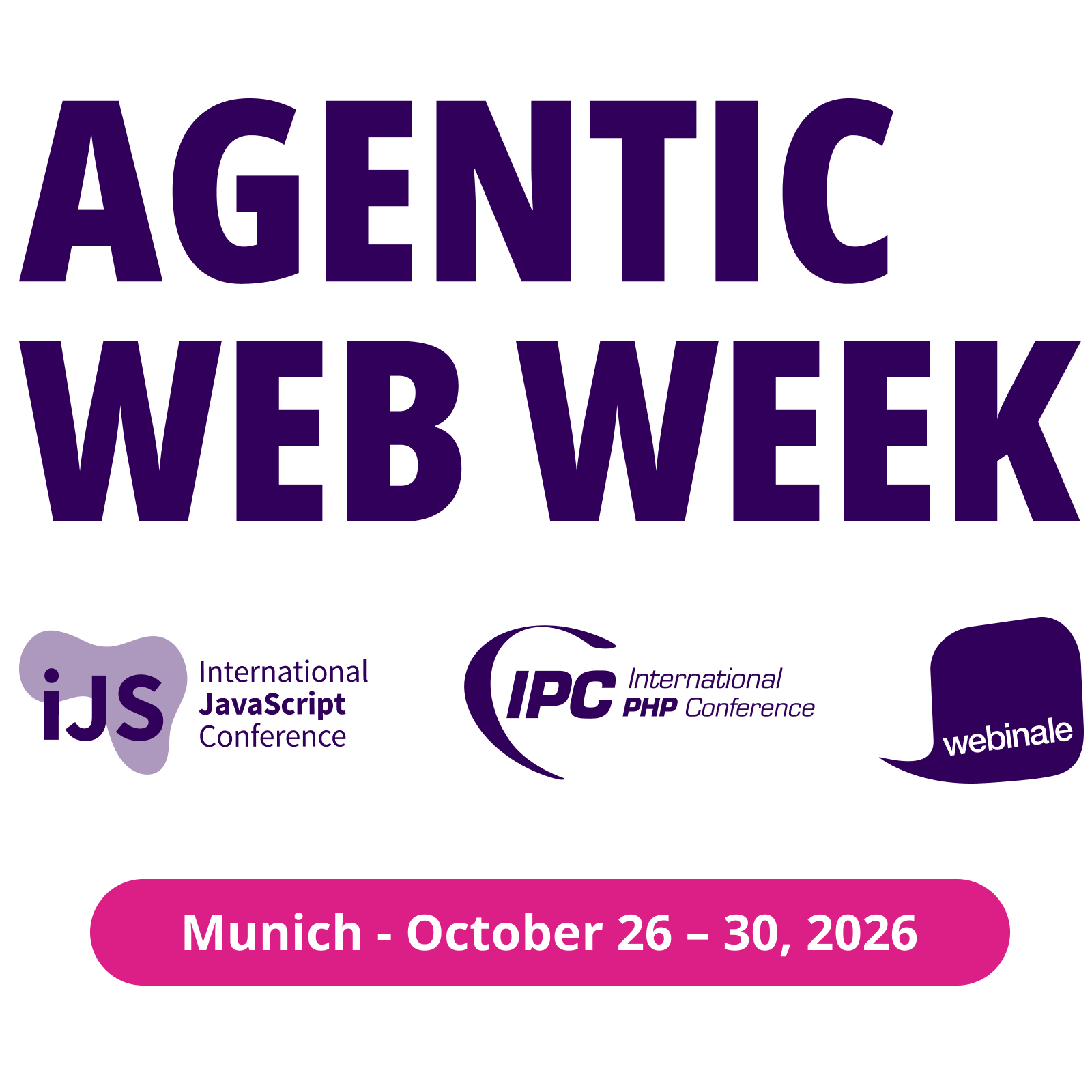
iJS Munich takes place within Agentic Web Week Munich, which brings together iJS, IPC, and webinale.
For teams whose work extends beyond JavaScript alone, the Full Week Pass can therefore offer an even broader return.
It includes workshops across all three conferences as well as recordings of 100+ sessions, creating access to expertise beyond the sessions one attendee can physically visit during the week.
That can be particularly valuable for cross-functional development teams working across frontend, architecture, AI, security, backend systems, and web technologies.
Instead of purchasing isolated training for individual topics, the week provides the opportunity to explore several connected challenges in one place.
What makes the workshops especially valuable?
Conference sessions are useful for orientation and new ideas. Workshops provide the time to apply those ideas in practice.
The program surrounding Agentic Web Week includes hands-on formats covering areas such as agentic UI development, LangChain, enterprise AI engineering, and web application performance.
Rather than leaving with only a list of tools to investigate later, workshops give you an opportunity to work through concepts, understand their limitations, and evaluate how they could fit your own projects.
This makes it easier to return to your team with something more concrete than inspiration: patterns, prototypes, architectural ideas, and practical next steps.
How can you convince your manager?
The strongest argument for attending iJS Munich 2026 is not simply that the conference covers current technologies.
It is that several decisions development teams are making right now are becoming increasingly difficult to separate.
Adopting AI coding tools is also an architecture decision.
Giving agents access to application functions is also a security decision.
Using proprietary code as AI context is also a privacy and governance decision.
Updating Angular, React, or Next.js affects both development productivity and maintainability.
And improving a codebase for AI-supported development often means improving it for human developers at the same time.
iJS Munich brings these questions together in one program and gives you the opportunity to evaluate them before committing your team to tools, architectures, or workflows that may be difficult to reverse later.